The Twelfth of July
Midwinter BreakThe Twelfth of July is an annual public marker in the novel, but its appearance is not a ceremonial set piece: it is felt through the crowded ferry traffic returning after the celebrations and through the history Gerry sees in the receding outline of Belfast. The date’s public, sectarian associations press against the Gilmore family’s small domestic scene, making a mid-July crossing carry both everyday and historical weight.
The ferry in mid-July
The date is established through its aftermath. In mid-July, Scottish bands and Orangemen are making their way home to Scotland after the Twelfth, and the bars and lounges are so crowded that ordinary travelling families seek quieter places elsewhere on the ferry. The floors are wet, the noise is deafening, the toilets are awash, and there is evidence that many passengers have been sick. Children run along the corridors and stairs, unaware of the situation around them. Stella, putting away the camera, says she will try to wait for the bathroom until the ferry reaches the Scottish terminal.
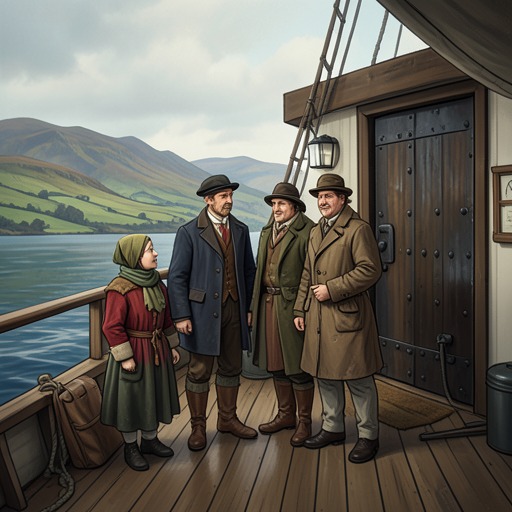
That disorder follows a family photograph taken on deck after a meal. Stella holds the toddler, with Gerry beside her; behind them, the pale wake runs back toward Belfast and seagulls trail the boat against a blue sky. The image offers a composed family unit, but the crossing around it is crowded and unsettled. The contrast makes the Twelfth visible not as an abstract date but as a pressure on shared public space, encountered by travellers with their own ordinary needs and routines.
Belfast in the rear view
Gerry looks back at Belfast and sees a column of black smoke rising above the city. He cannot tell whether it comes from a fire, a bomb, or a simple accident. As the wind thins it, the smoke becomes a dark halo over what he regards as a benighted, God-fearing place. The image makes the city recede physically while its history grows in his thoughts.
His reflection connects the scene to a long record of sectarian power and political violence. He recalls that the country was born amid sectarian hatred, that a prime minister declared he would not employ a Roman Catholic and urged others to follow suit, and that a right-wing Protestant majority governed for fifty years under British oversight. He also frames the British intervention as a failure to untangle a knot tied over centuries, and describes Bloody Sunday in Derry as echoing earlier British massacres committed in the service of empire. The passage does not identify the smoke as an event connected to the Twelfth; instead, the date’s crowded aftermath and Gerry’s historical account occupy the same moment of departure from Belfast.
Public observance and private ritual
The ferry scene belongs to a public calendar shaped by collective observance. Elsewhere, the novel sets such public time beside Stella’s quieter, repeated religious practices without making them part of the same occasion. At the hotel, Gerry sees her kneeling beside the bed in her white nightdress and stops himself from making a joke. Her prayers follow a routine: she remembers loved ones across her family, gives thanks for her survival, and prays for refugees and people fleeing war. She regards these regular prayers as a kind of spiritual tidying, performed before sleep and after waking.
Christmas offers a different instance of public religious ritual. Gerry remembers a Mass at which Stella and Sister Francis serve as Eucharistic ministers, distributing hosts from a gold chalice. Watching Stella on the altar, he sees her as old and realizes he does not fully know her; after returning to her seat, she bows her face into her hands and appears distressed. These scenes give the Twelfth a wider temporal contrast: collective dates and rituals may organize public life, while private faith is sustained through repeated acts whose meanings are not always visible even to a spouse.
A calendar against historical time
The Twelfth’s narrative force lies in this collision of scales. Its immediate evidence is material and social—the packed rooms, wet floors, exhausted families, and journey away from Belfast—while the city’s smoke opens Gerry’s thoughts onto decades of discrimination and violence. The ferry carries people home after a recurring date, but it does not carry the history away with them.
The novel’s other moments of prayer and worship deepen that contrast rather than supplying further facts about the Twelfth itself. Stella’s nightly petitions, her service at Christmas Mass, and the quiet church where Gerry catches sight of her belong to distinct scenes. Read alongside the July crossing, they distinguish public belonging from inward practice and calendar recurrence from the personal memories that persist beyond a particular day. At the close of the supplied sequence, Gerry offers the words “All shall be well,” and Stella asks him to say them again: a small exchange of reassurance set against the larger histories that no single date can settle.